
Back in December, when seizures were still new to us, I remember a phone call I had with our doctor in Tallinn at the time.
“How’s Eloise’s seizures?”
“Well, she’s having anywhere between 5-8 per day.”
“Okay, well, contact me if it gets worse.”
I remember feeling stunned. She doesn’t think a healthy kid having 5-8 seizures per day is abnormal? I mean, I thought it was scary but she’s the doctor. But in our planned Tartu hospital visit last week, the experience was like night and day different. On our last day there, we finally met our doctor in person. I asked her a clarifying question, “When do you want me to contact you?”
“I want you to contact me every time Eloise has a seizure, preferably if you can also get it on video and write the circumstances surrounding it.”
“Wait. EVERY time?”
“Yes. Every time.”
“But that might mean we contact you a lot.”
“That’s fine. I don’t mind.”
And that interaction basically sums up how different the care feels in Tartu versus Tallinn.
Summarizing our hospital stay
EEG results
Eloise’s EEG (the test where they measure her brain waves to look for seizure activity) came back even more clear than any of her previous ones. As the doctor said, “If I was to only look at her EEG, she shouldn’t be having any seizures at all. Which is why I really want you to contact me if she has one.”
However, we all know that, despite a clear EEG, Eloise was likely to have more seizures because of her SCN1A gene deletion. So it wasn’t a surprise to us when Eloise had 3 seizures this past weekend and then — boom, yet another tooth finally cut in yesterday. So we’ll go back to Tartu at the end of May and, at that time, they may start her on yet another anti-seizure medication. We’re hopeful it could be one of the newer FDA-approved drugs called Epidiolex that’s a synthetic CBD drug. It seems to not only help reduce seizures, but also helps with development for many kiddos. But let’s see. Obviously even better would be she just has no seizures but, well, that seems like a long shot.
Genetic tests
They re-did Eloise’s genetic testing in February to double check and make sure everything was correct. The results just came in and, well, not much has changed. Although we do know now that she’s missing a full copy of SCN1A — not a partial copy like the first test said. Unfortunately, there’s still almost no research out there on kids like her that are missing multiple sodium channels (the type of gene that SCN1A is), the least of which is studied is when they are like Eloise and are only missing SCN1A and SCN9A.
Neurological muscle issues
There’s a specific gene Eloise is missing that can cause neurological muscle disorders. Specifically, a disorder that is treatable by medicine. Another little boy like Eloise has already been diagnosed with it and then successfully treated. Looking through the symptoms, Eloise has some but not all. Yet as we approached several doctors, they didn’t seem to think she had it.
This time, the doctor in Tartu listened and actually ordered a test to check and see if Eloise had the syndrome. Surprisingly, the test DID show she has almost definitely has neurological muscle issues. Specifically, she likely has axonal type motor neuropathy — whatever that is. Regardless, the doctor said that one cannot be treated with medicine. Unfortunately, though, she moved around too much for them to be able to confirm or rule out the specific syndrome we were looking for. So, likely, we will have to get her in for another test to check.
Her little brain
This time, our doctor showed us a printout of her little brain from the MRI they took in February. You see those dark spots? They’re not supposed to be there.
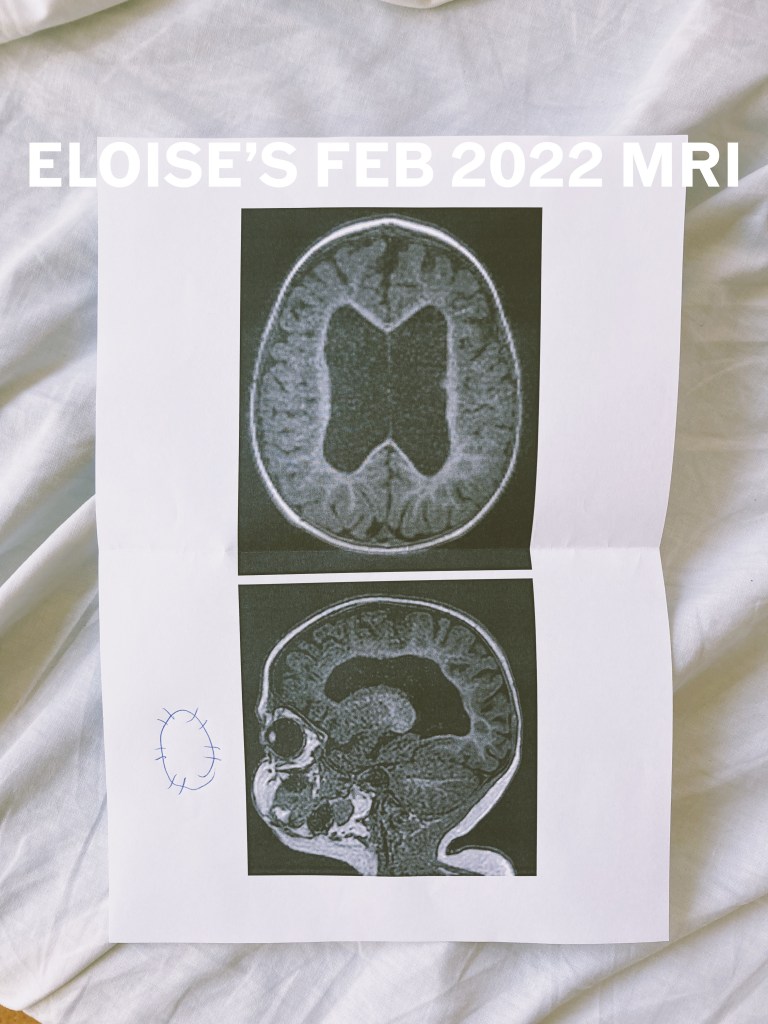
If my memory serves me correctly, the dark spots are cavities that are holding fluid. Apparently brain changes happen very slowly, so they won’t do another MRI until probably she’s around 2 years old — and decide then if she needs surgery to remove the fluid there.
But that’s not all the image shows. Apparently, Eloise has very little white matter (the glowing white stuff in the top image). What does that mean? White matter is kinda like the highways and streets that connect one part of the brain to another. When neurotypical babies are born, in order to function as a complete human being they have millions intricately built highways and streets all over their brain from the start, just waiting for some piece of information that needs to be carried from one part to another. As time goes on, their brains build even more roads. Eloise, however, was born with the equivalent of only a few dirt roads — and absolutely no paved streets or highways connecting big parts of the brain to another.
What does that mean? It means that most things — like speech — will just never happen for Eloise because even if we started digging a street by hand today, it wouldn’t be complete in her lifetime. So, in most things, without magic medical advancements, she won’t be like a normal kid ever. She just started too far behind. But.
But.
What our doctor did explain is that there ARE things we can do to help. Like putting her in the water every single day, as often as possible which apparently creates neural connections in her brain. Or doing the same physiotherapy exercise over and over and over and over again to help manually carve out streets in her brain that say “this is the way to go, kiddo!” So doing as many therapies as we can as many days a week as we can handle early on is key to helping her thrive.
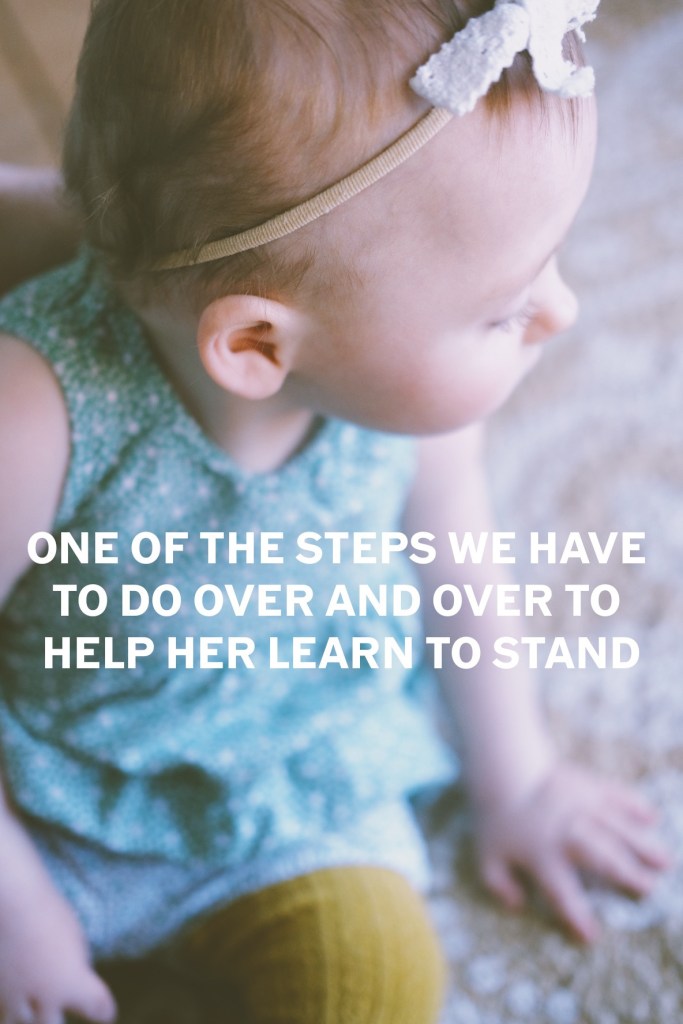
One cool thing is that the local pool offers moms and babies free entry. So that’s perfect, right? We can just take her to the pool every day. Well, I wish it were that easy. Even yesterday I planned to be brave and take Eloise to our local pool — a 15 minute drive away — but I didn’t manage it. Between her pain episodes, struggling to get her to eat anything, and an occupational therapy appointment, it was just too hard. And yesterday wasn’t even one of her super hard days.
The best pool for Eloise is the pool we’re actually able to use. So we decided decided to buy an electric hot tub for our backyard that we can keep regulated at a swimming pool temperature and use all year round. (Yes, it does sound cold to use a hot tub in our backyard in winter, but Estonians love ice swimming in winter, or jumping into a cold pool after a hot sauna so… it can’t be that bad. If it’s cold outside, we’ll just run the 10 seconds from the hot tub to inside the house where it’s warm and toasty.)
Sleep
One thing that’s already changed for us is Eloise’s sleep. With her teething pain, it’s been harder and harder and harder for her to fall asleep these last few months, no matter what we do. Many days she wouldn’t take a second nap because of the pain. Or, if she did, it’s often taken her 1.5-2 hours to fall asleep for a nap or at night. When you add in the fact that she seems to be more likely to have a seizure on a day she’s had less sleep on, well, it seems doubly important she get rest.
So our doctor explained to us that, due to her genetics, it’s very likely that Eloise’s brain doesn’t produce a sufficient amount of melatonin. That makes sense, because almost every kid we know of like her is on some sort of sleep medication. So our doctor gave us the go ahead to start giving melatonin to Eloise as often as we need — multiple times a day or even multiple times at night if she wakes up if she’s struggling to sleep.
This has been a game changer for us this week even in terms of rest. It means that both Brian and I are getting 1-2 hours back in our day that we don’t have to spend trying to soothe her to sleep. And, maybe it’s just my imagination, but she seems to be falling asleep much better and faster even without melatonin this last week, too. Most days she’s now getting 1-1.5 more hours of sleep a day. That’s pretty amazing.
Eloise’s eating
Several speech therapists so far have said, “I’m not worried about her eating.” Which, although somewhat comforting, doesn’t actually give us any information. Eloise has been able to eat more than puree but she still can’t, for example, take a bite out of a piece of broccoli and eat it.
So, while we were in Tartu, we asked to see a speech therapist to look at how Eloise eats and we got some clarity. The therapist said she was really impressed, actually, with Eloise’s eating. Essentially, Eloise doesn’t have any problems that need to be corrected (and her x-rays show she isn’t silently aspirating). Eloise’s eating skills are developing like a normal kid, just, well, waaaaay more slowly.
We asked what we could do to help her eat a bit more normally and handle harder textures. So she taught us to use corn puffs to help Eloise learn to bite and chew. They are a tough surface to cut through, but they will melt in her mouth so she can’t actually choke on the pieces. That was such a useful tip.
And, in the meantime, Brian and I are starting to actively try to offer her a little bit of our food every time we make a meal for ourselves. She even ate a few raviolis this week.
This kid is amazing.
The always-in-pain-doesn’t-want-to-eat phase
Friday I said to Brian, “Now that Eloise is finally eating some again and doesn’t seem to be in crisis, I can feel my brain suddenly has room to do things like think about different things we can do to help her development. It’s so nice to have a break.”
So Friday I took her to a quick grocery store trip. And Saturday I took her to the local open air farmer’s market.
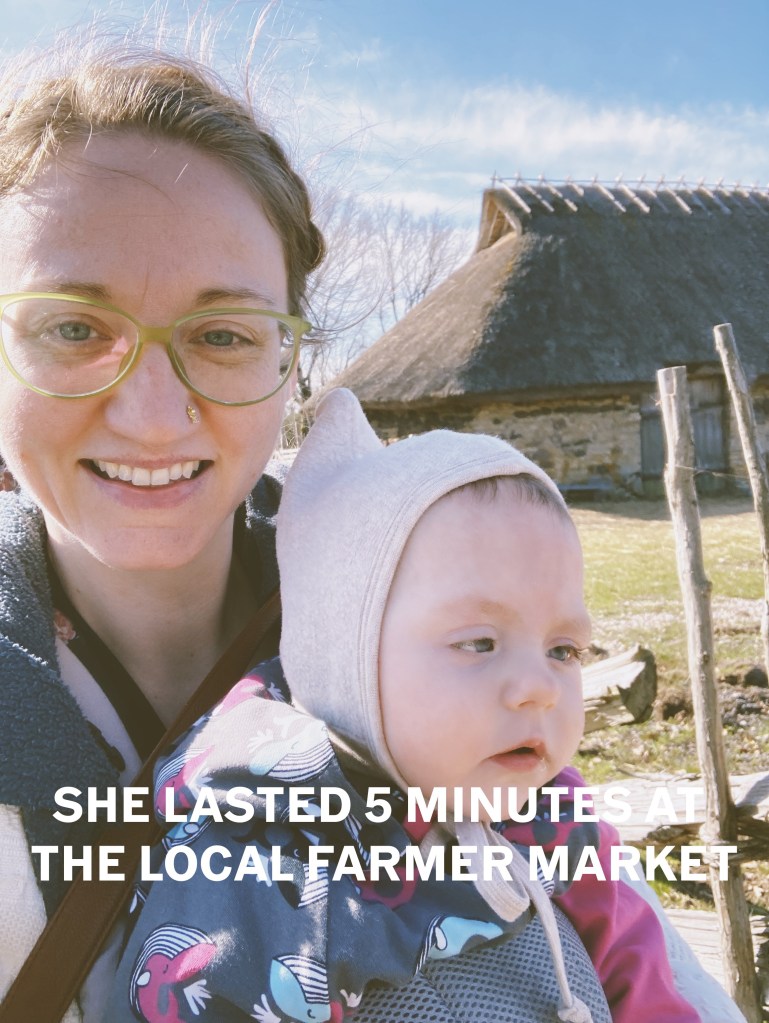
And then, by Saturday night her extreme pain, extreme not eating, and, well, seizures had started again.
So much for a mental break. 😅
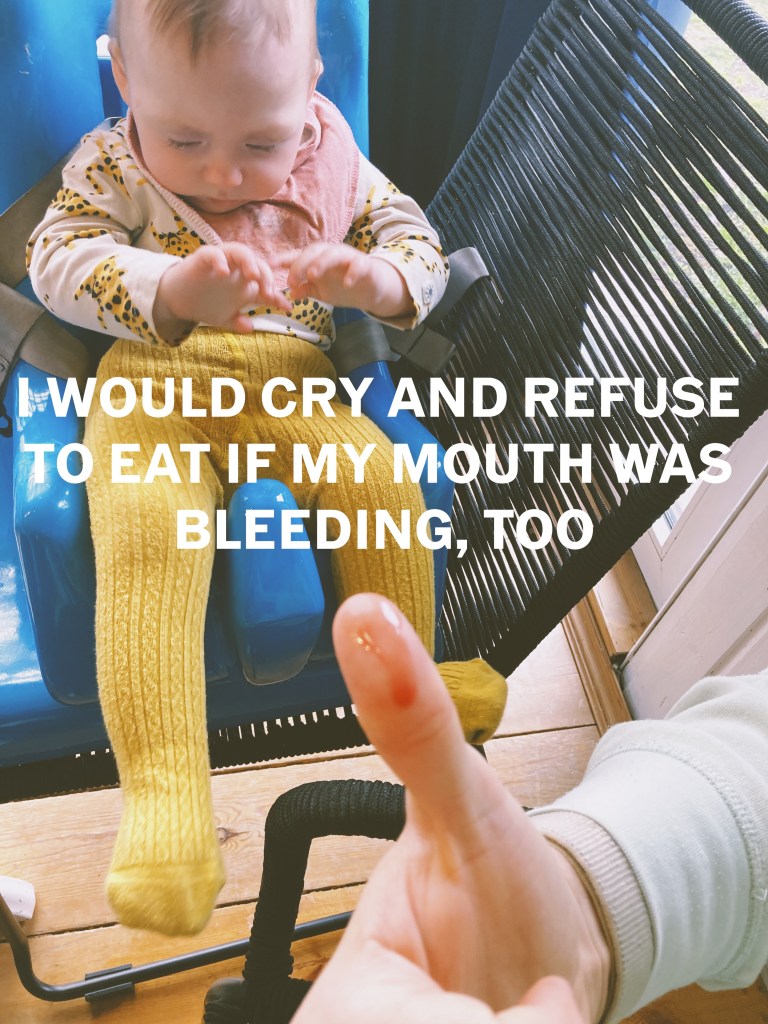
I try to weigh Eloise once a week just to make sure everything is mostly okay. And, well, this week, it wasn’t great. She had a pretty drastic weight drop — losing over 200grams (7oz) since last week. That means she dropped from the 4th/5th percentile to under the 3rd.
I mean, it makes sense. Over the weekend especially, as her gums literally bled, she didn’t want to eat or drink basically anything. Like, anything.
But I was encouraged to hear from a few other parents of “normal” kids that when their little ones were growing molars, they also lost weight and refused to eat. When I hear stories like that, it helps calm me and gives me hope that this phase is just temporary. We don’t have to start thinking about feeding tubes just yet. We just need to give her time. Hopefully. 🤞🤞🤞
But, gosh, I’m over this teething thing. Gone are the days when she was easily eating 400 grams per day in solids. These days we’re impressed if she even eats 50 grams in an entire day. I miss our always hungry always eating kiddo.
At least she’s happy more often than not.
Figuring out who’s going back to work in June
We feel really lucky for the fact that the Estonian government pays for one parent to stay home for 18 months. Last summer, when things with Eloise were really really rough and my mental health was not doing so hot, we decided I would go on unpaid leave and Brian would take off his own job and take the state-funded parental leave so we could both be home. But that paid leave runs out in June. So, unless we had some magic plan on how to pay our bills while getting zero income, that has meant that at least one of us has to go back to work to get an income.
April seemed a good time to figure that out, so Brian and I had some great conversations with both our employers and one another — deciding on our future goals and dreams, and figuring out what’s best for Eloise and our family.
Our priority is and has always been to make sure Eloise has great care. Which is why, whoever of us returned to work needed to have a role that, ideally, gave us energy.
Why was that important?
Because if we’re doing something at work that makes us come alive, then we’ll be better parents for Eloise after the workday is over. If we’re doing something at work that stresses us out or zaps our energy, then Eloise will bear the consequences of grumpier, less present parents. Considering this kid will never have the cognitive ability to go, “Oh, my parents are just grumpy because they wanted to make a lot of money to take care of me better,” and instead would think, “My parents are grumpy because I’m bad,” then, well, it’s doubly important we come home as happy and full of energy as we can.
After a few initial chats, I thought we had everything figured out. Brian’s prospective roles at work didn’t look too exciting, but we figured out a job at my workplace that I would love love love. So Brian was going to stay home fulltime with Eloise. (It also helped that he said, “If there’s anything in the world I could choose to do fulltime, it would be to spend my days with Eloise.”) Sure, on my salary alone we wouldn’t quite be able to pay our bills, but it’d be close. We decided that a happy home for Eloise was worth it, and we would somehow find a way to generate more income to make up the difference.
Then, on Monday, when Brian was having dinner with his lead, the two of them both realized of a role that Brian would be perfectly suited for and the company desperately needed. And, suddenly, Brian also wanted to go back to work.
So now that’s what’s going to happen. Or, well, that’s the tentative plan — I’ll work 4 days a week and Brian will work 3 days a week (in Estonia our medical is still paid for even if we’re part time) and we’ll need a caregiver to come twice a week for 4 hours each time.
If I’m honest, I feel quite intimidated by how busy our schedule will become overnight. I’m worried about getting enough time to feel rested and present for Eloise, and I’m worried about having enough time to continue our very long process of minimalizing.
But, well, like everything else, I assume we’ll figure out how to make it work as we go. I have to hope that by having jobs that give Brian and I energy rather than drain us, that we’ll be even better parents than ever for Eloise.
And, well, I’ll be honest, it also feels like a huge relief that we won’t need to worry about money with both of our salaries together.

This update is a bit long and dry this week, so I’ll end here. But, mostly, I’m just glad to see the sun out here in Estonia. It really does something wonderful to your moods — even if it did just snow a bit yesterday, too. 🤣
Hugs to you,
Mallory, Brian, and Eloise
 Eloise The Tiny Fighter